#How whe Simulated Annealing algorithm works
The description of the “More Pizza” algorithm have been provided in a previous post.
#The main() function
- Reading of the input parameters (input file name, specific procedure parameters, etc. ).
- Reading of input data and storage of the information in a proper data structure.
- The solving procedure.
- Validation of the result (optional, as it is done by Google itself)
- Output of the solution to a file (if not already done in the solving procedure).
#include <iostream>
#include <fstream>
#include <string>
#include <vector>
#include <algorithm>
#include <chrono>
#include <map>
#include <set>
#include <random>
#include <memory>

using namespace std;

// Default input and output filenames
string iFileName{ "..\a_example.in" };
string oFileName{ "..\a_example.out" };

// Max number of slices (capacity)
int32_t M{ 0 };

// Number available of pizzas
int32_t N{ 0 };

using TSol = vector<int32_t>; // it is used for both pizzas and solution
TSol pizzas{}; // storing number of slices of each pizza

// Random numbers generator
std::random_device rd;
std::mt19937 g(rd());
std::uniform_int_distribution<int32_t> rnProbValue(0, 100);
std::uniform_real_distribution<double> rnProb(0, 1);
// Number of neighbors to check
int32_t numMaxItemsToCheck{ 5u };
double T0 = 10000.0; // Default initial temperature
double ae = 0.000001; // Default reduction factor
int main(int argc, char* argv[])
{
    // Reading input parameters
    for (int i = 0; i < argc; i++)
    {
        cout << "argv[" << i << "] = " << argv[i] << endl;
    }
    if (argc > 1)
    {
        iFileName = argv[1];
        oFileName = iFileName;
        oFileName.append(".out");
        if (argc >= 3)
        {
            T0 = std::atof(argv[2]);
            if (argc >= 4)
            {
                numMaxItemsToCheck = std::atoi(argv[3]);
                if (argc >= 5)
                {
                    ae = std::atof(argv[4]);
                }
            }
        }
    }
    std::cout << "input file: " << iFileName << endl;
    std::cout << "output file: " << oFileName << endl;
    std::cout << "initial temperature: " << T0 << endl;
    std::cout << "alpha exp: " << ae << endl;
    std::cout << "num neighbours: " << numMaxItemsToCheck << endl;
    // Read data from input file
    readInput();
    auto start = chrono::steady_clock::now();
    orderPizzas();
    auto end = chrono::steady_clock::now();
    cout << "Elapsed time in milliseconds : "
        << chrono::duration_cast<chrono::milliseconds>(end - start).count()
        << " ms" << endl;
    return 0;
}
#Reading data from a file
// Read input data from a file
void readInput()
{
    ifstream iFile;
    iFile.open(iFileName);
    iFile >> M; // Maximum number of slices (i.e., max score)
    iFile >> N; // Number of pizzas
    std::cout << "Max. num. slices: " << M << endl;
    std::cout << "N. pizzas: " << N << endl;
    //init pizzas vector
    pizzas.reserve(N);
    for (int32_t i = 0; i < N; i++)
    {
        int32_t tmpPizza{};
        iFile >> tmpPizza;
        pizzas.emplace_back(tmpPizza);
    }
    iFile.close();
    pizzas.shrink_to_fit();
    std::cout << "DONE!" << endl;
}
#The solution class
- store the actual solution.
- store the score of the solution.
- save the “state” of a solution (e.g., which pizzas can be added to the current solution).
- implement utility functions to: -- create an empty solution (i.e., having zero score). -- create a random solution. -- change the current solution in a random way (please, check mutate() function). -- calculate the score of the solution (please, check score() function). -- save the solution into a file with the required format (please, check the function saveSolutionToFile() ). -- print the current solution to screen
// Container used to store the solution
// including its "state". The state of
// a solution is required to quickly change it
// and generate a new "neighbour"
struct TSolCnt
{
    // This constructor is used to create an empty solution
    TSolCnt() : sol{}, score{0}, availablePizzas(N,0)
    {
        // Initially, all pizzas are available
        for (int i = 0; i < N; i++)
        {
            availablePizzas[i]=i;
        }
    }
    // Constructor used to make an initial random solution
    TSolCnt( std::uniform_int_distribution<>& rnPizzaID ) :
        sol(), // empty solution
        score(0), // initial score
        availablePizzas(N,0)
    {
        // Initially, all pizzas are available
        for (int i = 0; i < N; i++)
        {
            availablePizzas[i] = i;
        }
        // Pizzas that cannot be used will be stored at the end of this vector
        std::sort(availablePizzas.begin(), availablePizzas.end(),[&](int a, int b)
        {
            return (M - (score + pizzas[a])) > (M - (score + pizzas[b]));
        });
        while ( score < M &&
            ( !availablePizzas.empty() && ( M - ( score + pizzas[availablePizzas.front()]))>0 ))
        {
            auto it_end = std::find_if(availablePizzas.cbegin(),
                availablePizzas.cend(),
                [&](int idx) {
                    return (M - (score + pizzas[idx])) < 0;
                });
            const auto numElToCheck = std::distance(availablePizzas.cbegin(), it_end);
            const int32_t avIdx = rnPizzaID(g) % numElToCheck;
            const auto searchIt = std::next(availablePizzas.cbegin(), avIdx);
            const int32_t searchIdx = *searchIt;
            if ( (pizzas[searchIdx] + score) <= M)
            {
                sol.emplace_back(searchIdx);
                score += pizzas[searchIdx];
                availablePizzas.erase(searchIt);
                cout << "searchIdx: " << searchIdx << ", score: " << score << "tr";
                // Sorting indexes by our criteria in descending order
                std::sort(availablePizzas.begin(), availablePizzas.end(), [&](int a, int b)
                {
                    return (M - (score + pizzas[a])) > (M - (score + pizzas[b]));
                });
                // Sorting indexes
                std::sort(sol.begin(), sol.end());
            }
        }
    }
    TSolCnt& operator= (const TSolCnt& rhs)
    {
        score = rhs.score;
        sol.assign(rhs.sol.begin(), rhs.sol.end());
        availablePizzas = rhs.availablePizzas;
        return *this;
    };
    void mutate(
        std::uniform_int_distribution<int32_t>& rnPizzaID,
        const int32_t maxNumRemovals)
    {
        const int32_t oldSize = static_cast<int32_t>(sol.size());
        int32_t numRemovals = 0;
        do
        {
            // find a pizza to remove
            const int32_t searchIdx = sol[rnPizzaID(g) % sol.size()];
            // update set of available pizzas
            availablePizzas.emplace_back(searchIdx);
            // update solution and its score
            score -= pizzas[searchIdx];
            auto it = std::find(sol.cbegin(), sol.cend(), searchIdx);
            sol.erase(it);
            // increase counter
            ++numRemovals;
        } while (!sol.empty()
            && (sol.size() == oldSize || numRemovals < maxNumRemovals));
        // Sorting indexes by our criteria in descending order
        std::sort(availablePizzas.begin(), availablePizzas.end(), [&](int a, int b)
        {
            return (M - (score + pizzas[a])) >(M - (score + pizzas[b]));
        });
        // adding slices to fill the order
        while (score < M &&
            (!availablePizzas.empty() && ( M - ( score + pizzas[availablePizzas.front() ] ) ) >=0 ) )
        {
            const int32_t avIdx = rnPizzaID(g) % availablePizzas.size();
            const auto searchIt = std::next(availablePizzas.cbegin(), avIdx);
            const int32_t searchIdx = *searchIt;
            if ((pizzas[searchIdx] + score) <= M)
            {
                sol.emplace_back(searchIdx);
                score += pizzas[searchIdx];
                availablePizzas.erase(searchIt);
                // Sorting indexes by our criteria in descending order
                std::sort(availablePizzas.begin(), availablePizzas.end(), [&](int a, int b)
                {
                    return (M - (score + pizzas[a])) > (M - (score + pizzas[b]));
                });
                // Sorting indexes
                std::sort(sol.begin(), sol.end());
            }
        }
    }
    // Helper function to print the solution
    void print()
    {
        std::cout << "Ordering " << sol.size() << " pizzas:" << std::endl;
        int32_t score = 0;
        for (auto item : sol)
        {
            std::cout << item << " ";
            score += pizzas[item];
        }
        cout << endl;
        cout << "Score: " << score << endl;
    }
    // Save solution to a file.
    // The name of the file is SCENARIO + "_" + SCORE + ".txt"
    void saveSolutionToFile()
    {
        // print to a file
        ofstream outFile;
        outFile.open(iFileName + "_" + to_string(score) + ".out");
        outFile << sol.size() << endl;
        int x = 0;
        for (auto& item : sol)
        {
            outFile << item;
            if (x < static_cast<int32_t>(sol.size() - 1))
            {
                outFile << " ";
            }
            ++x;
        }
        outFile << endl;
        outFile.close();
    }
    TSol sol; // vector of indexes of the pizzas
    int32_t score; // score of the current solution
    // Set storing the indexes of the available pizzas
    // This vector will be always sorted in a descending order
    // by the difference <M - (score + pizzas[index])>, where index
    // refers to each value stored inside this vector.
    TSol availablePizzas;
};
#How to quickly calculate new solutions?
For this reason, in the mutate() function, after a certain number of pizzas have been randomly removed, then only the pizzas that can effectively contribute to the solution are considered in the selection process.
#The orderPizzas() function
As described in this post, the used algorithm is a “Simulated Annealing” procedure. Please, find the implementation of that algorithm below:
// Using smart pointers, it is straightforward and faster
// to replace local solution with a better solution.
using TSolPtr = std::shared_ptr<TSolCnt>;
void orderPizzas()
{
    const int32_t numEl{ static_cast<int32_t>( pizzas.size() ) };
    // This is used to choose randomly a pizza to order or remove
    std::uniform_int_distribution<int32_t> rnPizzaID(0, numEl - 1);
    // Counters
    int32_t numItBetweenImprovement = 0;
    int32_t cntIters{ 0 };
    cout << "...ok! Ready to start..." << endl;
    // make local initial solution
    TSolPtr localSol = std::make_shared<TSolCnt>(rnPizzaID);
    localSol->saveSolutionToFile();
    // this is the best solution until now found... so let's save it!
    TSolPtr savedSol = std::make_shared<TSolCnt>(*localSol);
    // Print some data...
    cout << "Initial score: " << savedSol->score << "tsize: " << savedSol->sol.size() << endl;
#ifdef _DEBUG
    savedSol->print();
#endif // _DEBUG
    double temperature = T0; // initialize temperature
    while (savedSol->score<M && numItBetweenImprovement < 500'000)
    {
        // Calculating new temperature
        ++cntIters;
        temperature = T0 * exp(-ae * cntIters);
        // Calculating the number of pizzas to be replaced
        const auto maxNumRemovals = 1 + numItBetweenImprovement / 100;
        // creating new solutions from current one!
        TSolPtr bestNb = std::make_shared<TSolCnt>(); // with zero score
        for (auto i = 0; i < numMaxItemsToCheck; i++)
        {
            // Creating a copy of the local solution
            TSolPtr nb = std::make_shared<TSolCnt>(*localSol);
            if (nb)
            {
                // Mutate the new solution
                nb->mutate(rnPizzaID, maxNumRemovals);
                // Checking if the new solution is better
                if (nb->score > bestNb->score )
                {
                    bestNb.swap(nb);
                }
            }
        }
        const int32_t deltaEnergy = bestNb->score - savedSol->score;
        // If a better solution is found
        if (bestNb->score>0 && deltaEnergy > 0)
        {
            savedSol.swap(bestNb);
            localSol = std::make_shared<TSolCnt>(*savedSol);
            savedSol->saveSolutionToFile();
            cout << "New max score: " << savedSol->score << "tsize: " << savedSol->sol.size();
            cout << "tTemperature: " << temperature;
            cout << "tdelta: " << deltaEnergy;
            cout << "tnumItBetweenImprovements: " << numItBetweenImprovement << endl;
            numItBetweenImprovement = 0;
#ifdef _DEBUG
            savedSol->print();
#endif // _DEBUG
        }
        else
        {
            // check if it can be accepted
            const auto probAccept = 1.0 / (1 + exp(-deltaEnergy / temperature));
            if (rnProb(g) < probAccept) // accepted
            {
                localSol.swap(bestNb);
                cout << "Accepted lower score: " << localSol->score << "tsize: " << localSol->sol.size();
            }
            else
            {
                // Reset local solution to be equal to the best one found until now
                localSol = std::make_shared<TSolCnt>(*savedSol);
                cout << "Unaccepted lower score: " << bestNb->score << "tsize: " << bestNb->sol.size();
            }
            cout << "tTemperature: " << temperature;
            cout << "tProbAccept: " << probAccept;
            cout << "tnumIts: " << numItBetweenImprovement << "r";
            ++numItBetweenImprovement;
        }
    }
#ifdef _DEBUG
    savedSol->print();
#endif // _DEBUG
}
#The console output
The algorithm has been executed for all the unsolved test scenarios, as shown in the following images.
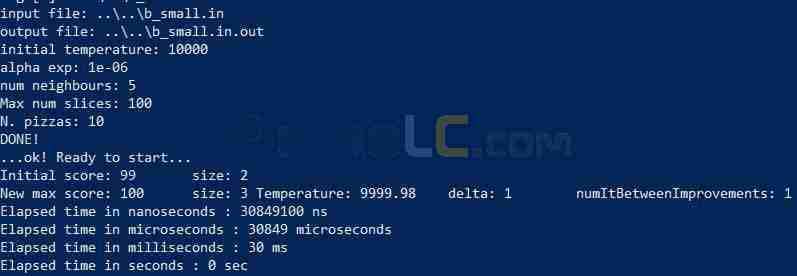 Small
Small
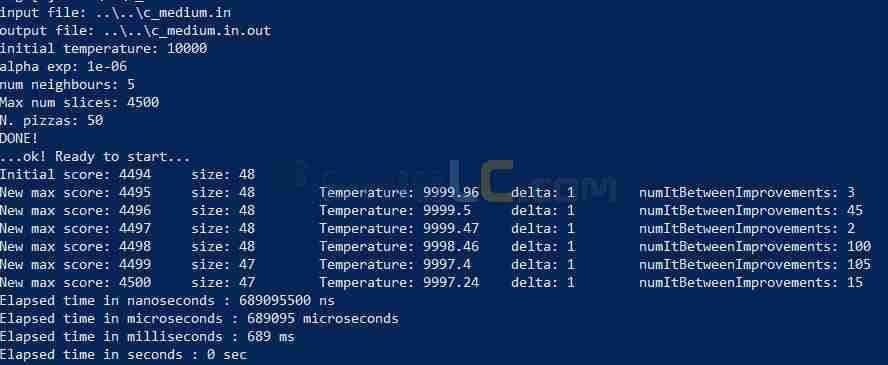 Medium
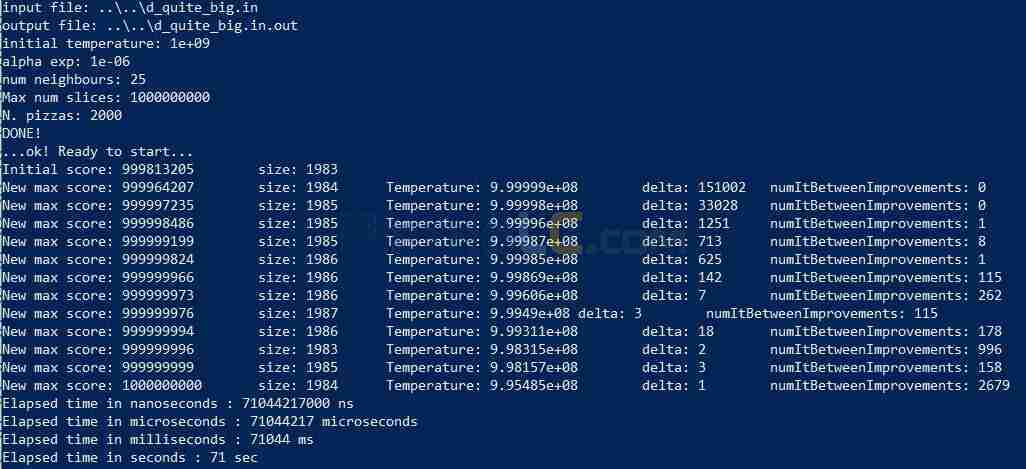 Quite big
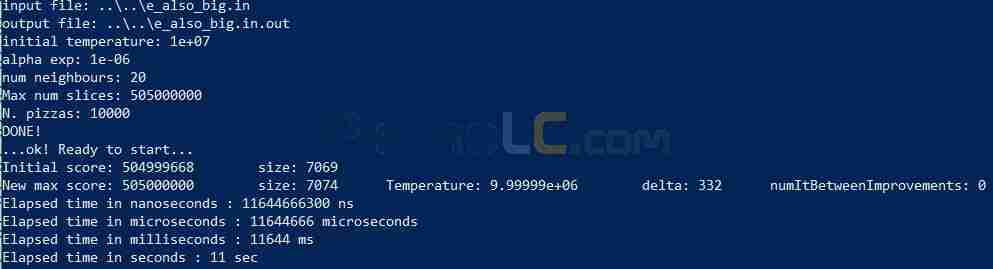 Also Big
#Results for each test scenario
| Scenario | Average execution time |
|---|---|
| Small | < 1s |
| Medium | < 1s |
| Quite Big | 1-2 minutes |
| Also Big | < 1s |
#The complete code
// Author: Pietro L. Carotenuto
// Website: https://www.pietrolc.com
#include "stdafx.h"
#include <iostream>
#include <fstream>
#include <string>
#include <vector>
#include <algorithm>
#include <chrono>
#include <map>
#include <set>
#include <random>
#include <memory>

using namespace std;

// Default input and output filenames
string iFileName{ "..\a_example.in" };
string oFileName{ "..\a_example.out" };

// Max number of slices (capacity)
int32_t M{ 0 };
// Number available of pizzas
int32_t N{ 0 };
using TSol = vector<int32_t>; // it is used for both pizzas and solution
TSol pizzas{}; // storing number of slices of each pizza

// Random numbers generator
std::random_device rd;
std::mt19937 g(rd());
std::uniform_int_distribution<int32_t> rnProbValue(0, 100);
std::uniform_real_distribution<double> rnProb(0, 1);

// Number of neighbours to check
int32_t numMaxItemsToCheck{ 5u };
double T0 = 10000.0; // Default initial temperature
double ae = 0.000001; // Default reduction factor

// Read input data from a file
void readInput()
{
    ifstream iFile;
    iFile.open(iFileName);
    iFile >> M;
    iFile >> N;
    std::cout << "Max num slices: " << M << endl;
    std::cout << "N. pizzas: " << N << endl;
    //init pizzas vector
    pizzas.reserve(N);
    for (int32_t i = 0; i < N; i++)
    {
        int32_t tmpPizza{};
        iFile >> tmpPizza;
        pizzas.emplace_back(tmpPizza);
    }
    iFile.close();
    pizzas.shrink_to_fit();
    std::cout << "DONE!" << endl;
}
// Container used to store the solution
// including its "state". The state of
// a solution is required to quickly change it
// and generate a new "neighbour"
struct TSolCnt
{
    TSolCnt() : sol{}, score{0}, availablePizzas(N,0)
    {
        for (int i = 0; i < N; i++)
        {
            availablePizzas[i]=i;
        }
    }

    // Constructor used to make an initial solution
    TSolCnt( std::uniform_int_distribution<>& rnPizzaID ) :
        sol(), // empty solution
        score(0), // initial score
        availablePizzas(N,0)
    {
        for (int i = 0; i < N; i++)
        {
            availablePizzas[i] = i;
        }
        // Sorting indexes by our criteria in descending order
        std::sort(availablePizzas.begin(), availablePizzas.end(),[&](int a, int b)
        {
            return (M - (score + pizzas[a])) > (M - (score + pizzas[b]));
        });
        while ( score < M &&
            ( !availablePizzas.empty() && ( M - ( score + pizzas[availablePizzas.front()]))>0 ))
        {
            auto it_end = std::find_if(availablePizzas.cbegin(),
                availablePizzas.cend(),
                [&](int idx) {
                    return (M - (score + pizzas[idx])) < 0;
                });
            const auto numElToCheck = std::distance(availablePizzas.cbegin(), it_end);
            const int32_t avIdx = rnPizzaID(g) % numElToCheck;
            const auto searchIt = std::next(availablePizzas.cbegin(), avIdx);
            const int32_t searchIdx = *searchIt;
            if ( (pizzas[searchIdx] + score) <= M)
            {
                sol.emplace_back(searchIdx);
                score += pizzas[searchIdx];
                availablePizzas.erase(searchIt);
                cout << "searchIdx: " << searchIdx << ", score: " << score << "tr";
                // Sorting indexes by our criteria in descending order
                std::sort(availablePizzas.begin(), availablePizzas.end(), [&](int a, int b)
                {
                    return (M - (score + pizzas[a])) > (M - (score + pizzas[b]));
                });
                // Sorting indexes
                std::sort(sol.begin(), sol.end());
            }
        }
    }

    TSolCnt& operator= (const TSolCnt& rhs)
    {
        score = rhs.score;
        sol.assign(rhs.sol.begin(), rhs.sol.end());
        availablePizzas = rhs.availablePizzas;
        return *this;
    };

    void mutate(
        std::uniform_int_distribution<int32_t>& rnPizzaID,
        const int32_t maxNumRemovals)
    {
        const int32_t oldSize = static_cast<int32_t>(sol.size());
        int32_t numRemovals = 0;
        do
        {
            // find a pizza to remove
            const int32_t searchIdx = sol[rnPizzaID(g) % sol.size()];
            // update set of available pizzas
            availablePizzas.emplace_back(searchIdx);
            // update solution and its score
            score -= pizzas[searchIdx];
            auto it = std::find(sol.cbegin(), sol.cend(), searchIdx);
            sol.erase(it);
            // increase counter
            ++numRemovals;
        } while (!sol.empty()
            && (sol.size() == oldSize || numRemovals < maxNumRemovals));
        // Sorting indexes by our criteria in descending order
        std::sort(availablePizzas.begin(), availablePizzas.end(), [&](int a, int b)
        {
            return (M - (score + pizzas[a])) >(M - (score + pizzas[b]));
        });
        // adding slices to fill the order
        while (score < M &&
            (!availablePizzas.empty() && ( M - ( score + pizzas[availablePizzas.front() ] ) ) >=0 ) )
        {
            const int32_t avIdx = rnPizzaID(g) % availablePizzas.size();
            const auto searchIt = std::next(availablePizzas.cbegin(), avIdx);
            const int32_t searchIdx = *searchIt;
            if ((pizzas[searchIdx] + score) <= M)
            {
                sol.emplace_back(searchIdx);
                score += pizzas[searchIdx];
                availablePizzas.erase(searchIt);
                // Sorting indexes by our criteria in descending order
                std::sort(availablePizzas.begin(), availablePizzas.end(), [&](int a, int b)
                {
                    return (M - (score + pizzas[a])) > (M - (score + pizzas[b]));
                });
                // Sorting indexes
                std::sort(sol.begin(), sol.end());
            }
        }
    }

    // Helper function to print the solution
    void print()
    {
        std::cout << "Ordering " << sol.size() << " pizzas:" << std::endl;
        int32_t score = 0;
        for (auto item : sol)
        {
            std::cout << item << " ";
            score += pizzas[item];
        }
        cout << endl;
        cout << "Score: " << score << endl;
    }

    // Save solution to a file.
    // The name of the file is SCENARIO + "_" + SCORE + ".txt"
    void saveSolutionToFile()
    {
        // print to a file
        ofstream outFile;
        outFile.open(iFileName + "_" + to_string(score) + ".out");
        outFile << sol.size() << endl;
        int x = 0;
        for (auto& item : sol)
        {
            outFile << item;
            if (x < static_cast<int32_t>(sol.size() - 1))
            {
                outFile << " ";
            }
            ++x;
        }
        outFile << endl;
        outFile.close();
    }
    TSol sol; // vector of indexes of the pizzas
    int32_t score; // score of the current solution
    // Set storing the indexes of the available pizzas
    // This vector will be always sorted in a descending order
    // by the difference <M - (score + pizzas[index])>, where index
    // refers to each value stored inside this vector.
    TSol availablePizzas;
};

// Using smart pointers, it is straightforward and faster
// to replace local solution with a better solution.
using TSolPtr = std::shared_ptr<TSolCnt>;
void orderPizzas()
{
    const int32_t numEl{ static_cast<int32_t>( pizzas.size() ) };
    // This is used to choose randomly a pizza to order or remove
    std::uniform_int_distribution<int32_t> rnPizzaID(0, numEl - 1);
    // Counters
    int32_t numItBetweenImprovement = 0;
    int32_t cntIters{ 0 };
    cout << "...ok! Ready to start..." << endl;
    // make local initial solution
    TSolPtr localSol = std::make_shared<TSolCnt>(rnPizzaID);
    localSol->saveSolutionToFile();
    // this is the best solution until now found... so let's save it!
    TSolPtr savedSol = std::make_shared<TSolCnt>(*localSol);
    // Print some data...
    cout << "Initial score: " << savedSol->score << "tsize: " << savedSol->sol.size() << endl;
#ifdef _DEBUG
    savedSol->print();
#endif // _DEBUG
    double temperature = T0; // initialize temperature
    while (savedSol->score<M && numItBetweenImprovement < 500'000)
    {
        // Calculating new temperature
        ++cntIters;
        temperature = T0 * exp(-ae * cntIters);
        // Calculating the number of pizzas to be replaced
        const auto maxNumRemovals = 1 + numItBetweenImprovement / 100;
        // creating new solutions from current one!
        TSolPtr bestNb = std::make_shared<TSolCnt>(); // with zero score
        for (auto i = 0; i < numMaxItemsToCheck; i++)
        {
            // Creating a copy of the local solution
            TSolPtr nb = std::make_shared<TSolCnt>(*localSol);
            if (nb)
            {
                // Mutate the new solution
                nb->mutate(rnPizzaID, maxNumRemovals);
                // Checking if the new solution is better
                if (nb->score > bestNb->score )
                {
                    bestNb.swap(nb);
                }
            }
        }
        const int32_t deltaEnergy = bestNb->score - savedSol->score;
        // If a better solution is found
        if (bestNb->score>0 && deltaEnergy > 0)
        {
            savedSol.swap(bestNb);
            localSol = std::make_shared<TSolCnt>(*savedSol);
            savedSol->saveSolutionToFile();
            cout << "New max score: " << savedSol->score << "\tsize: " << savedSol->sol.size();
            cout << "\tTemperature: " << temperature;
            cout << "\tdelta: " << deltaEnergy;
            cout << "\tnumItBetweenImprovements: " << numItBetweenImprovement << endl;
            numItBetweenImprovement = 0;
#ifdef _DEBUG
            savedSol->print();
#endif // _DEBUG
        }
        else
        {
            // check if it can be accepted
            const auto probAccept = 1.0 / (1 + exp(-deltaEnergy / temperature));
            if (rnProb(g) < probAccept) // accepted
            {
                localSol.swap(bestNb);
                cout << "Accepted lower score: " << localSol->score << "\tsize: " << localSol->sol.size();
            }
            else
            {
                // Reset local solution to be equal to the best one found until now
                localSol = std::make_shared<TSolCnt>(*savedSol);
                cout << "Unaccepted lower score: " << bestNb->score << "\tsize: " << bestNb->sol.size();
            }
            cout << "\tTemperature: " << temperature;
            cout << "\tProbAccept: " << probAccept;
            cout << "\tnumIts: " << numItBetweenImprovement << "\r";
            ++numItBetweenImprovement;
        }
    }

#ifdef _DEBUG
    savedSol->print();
#endif // _DEBUG

}
int main(int argc, char* argv[])
{
    // Reading algorithm parameters
    for (int i = 0; i < argc; i++)
        cout << "argv[" << i << "] = " << argv[i] << endl;
    if (argc > 1)
    {
        iFileName = argv[1];
        oFileName = iFileName;
        oFileName.append(".out");
        if (argc >= 3)
        {
            T0 = std::atof(argv[2]);
            if (argc >= 4)
            {
                numMaxItemsToCheck = std::atoi(argv[3]);
                if (argc >= 5)
                {
                    ae = std::atof(argv[4]);
                }
            }
        }
    }

    std::cout << "input file: " << iFileName << endl;
    std::cout << "output file: " << oFileName << endl;
    std::cout << "initial temperature: " << T0 << endl;
    std::cout << "alpha exp: " << ae << endl;
    std::cout << "num neighbours: " << numMaxItemsToCheck << endl;
    // Read data from input file
    readInput();
    auto start = chrono::steady_clock::now();
    orderPizzas();
    auto end = chrono::steady_clock::now();
    cout << "Elapsed time in milliseconds : "
        << chrono::duration_cast<chrono::milliseconds>(end - start).count()
        << " ms" << endl;
    return 0;
}
#New code - using OOP design - is on Github
After five years, I've found the time to refactor this original code I used for the Google HashCode challenge. I've decided to split this large piece of code into smaller classes. The complete and updated code can be found here: SimulatedAnnealingCpp repo.